
Money questions, explained
What is financial independence and which assets count?
Financial independence means being able to cover your living costs without relying on employment income. The useful question is which resources can actually support those costs, and when.
Three different views of your wealth
Net worth is everything you count as an asset, minus your liabilities. It can include a home or collection you have no intention of selling.
Accessible assets are resources you can use when needed. Access can be limited by pension rules, withdrawal restrictions, the time needed to sell, or transaction costs. A traded investment can be easy to sell while still changing substantially in price.
Funding assets are the resources you select for a particular goal. They are a planning choice, not another name for net worth. You may keep emergency cash separate or exclude a home because you plan to live in it.
The SEC’s Investor.gov guide explains the assets-minus-liabilities starting point. Our balance-sheet guide and calculator help you record it consistently.
A home, investments and three watches
| Item | Value | Selected for the goal? |
|---|---|---|
| Home | €280,000 | No, still living there |
| Accessible investments | €150,000 | Yes |
| Emergency cash | €15,000 | No, kept as a reserve |
| Watch collection | €9,000 | No, no planned sale |
| Mortgage owed | €160,000 | A liability, not a funding asset |
Total assets are €454,000. Subtracting the mortgage gives €294,000 net worth. The assets selected to fund the goal total €150,000. Neither number by itself tells us whether the plan can support someone’s spending.
The mortgage still matters. Include its payments in the spending plan, or model a planned payoff and reduce available funding accordingly. Do not subtract the same repayment twice. Watch values are estimates, not appraisals or guaranteed sale proceeds.
Net worth, liquid net worth and funding assets
These totals answer different questions. Net worth describes your balance sheet. Liquid net worth focuses on assets that can be turned into cash readily, less liabilities under the definition you use. Funding assets are the assets you deliberately select for a goal; they are not automatically liquid or debt-free.
| Measure | Calculation in this example | Result |
|---|---|---|
| Total net worth | €280,000 home + €150,000 investments + €15,000 cash + €9,000 watches − €160,000 mortgage | €294,000 |
| Liquid net worth | €150,000 readily saleable investments + €15,000 cash − all €160,000 liabilities | €5,000 |
| Selected funding assets | €150,000 investments; emergency cash, home and watches excluded by choice | €150,000 |
Here the investments are assumed to be accessible and readily saleable; the home and watches are excluded from liquid assets. The €5,000 figure subtracts the entire mortgage balance, not just its next payment. It is neither cash in the bank nor a measure of this month’s bills.
Definitions of liquid net worth vary, especially on financial-provider forms. Follow the definition requested and state your exclusions. Sale costs, taxes, settlement time and withdrawal restrictions can reduce usable proceeds. Do not treat this simplified table as the app’s calculation of a separate liquid-net-worth metric.
The selected €150,000 is a gross asset pool. Mortgage payments still belong in the spending plan, unless a separately modelled payoff reduces the pool. An emergency reserve can be liquid while deliberately excluded from retirement funding.
Does my home or collection count toward financial independence?
A home can count toward net worth without funding retirement spending. Include its full estimated value as an asset and the mortgage as a liability. If you intend to live there, do not also assume its sale value is available to spend.
A sale or downsizing plan needs an expected date, selling costs, the debt to repay and replacement housing. Only the proceeds left after those uses could support other spending. If a mortgage is already deducted from sale proceeds, do not deduct the same payoff again.
A collection can count toward wealth without being an FI funding asset. Include a realistic estimate once, either through the individual pieces or a collection total. Select it for a goal only if selling is part of the plan; allow for uncertain prices, fees and the time needed to find a buyer. See the collection-tracking example.
Pensions raise a different issue: money may be intended for later retirement but unavailable at an earlier target age. Model the intervening years separately and verify the rules for the account and country concerned.
Build the spending side first
List housing, everyday costs, debt payments, insurance, healthcare, irregular purchases and expected taxes. Work in today’s purchasing power so inflation is handled consistently. A total of assets has little meaning without a time horizon and an estimate of what it needs to pay for.
For scale only, spending €24,000 a year for 30 years with no real investment growth requires €720,000 at the start, assuming end-of-month spending and no income from elsewhere. That leaves no reserve at the end. It is arithmetic, not a recommended retirement target.
Employment flexibility, pension income and a later retirement date can change the picture. Pension access ages and benefits are country-specific; verify them separately. Our retirement scenario calculator shows how assumptions change the result without assigning a probability of success.
What is Coast FIRE?
Coast FIRE is a projected future milestone: the investments already set aside could grow to a later retirement target with little or no further saving. You still need to fund living costs until then, usually through work. Financial independence today means the resources can support your life now.
Schwab’s FIRE overview describes Coast FIRE as allowing existing investments time to grow toward a future goal. The example below explores the no-further-contributions version. It is our own simplified calculation, not a forecast or a recommendation to stop saving.
A fictional 30-year example
Suppose someone aged 35 chooses a target of €600,000 at age 65, measured in today’s purchasing power. This is an assumed target, not a recommended retirement amount. With no contributions or withdrawals before 65, the amount needed today is:
Amount today = future target ÷ (1 + annual real return)^years
| Constant annual real return | Amount needed today |
|---|---|
| 0% | €600,000 |
| 2% | €331,243 |
| 3% | €247,192 |
| 4% | €184,991 |
“Real” means after inflation; here the rate is also assumed to be after fees and any tax drag during growth. Actual returns are uneven and can be negative. Taxes on retirement withdrawals, account access and the spending the target must support need separate treatment. A higher assumed return lowers the starting amount without making that outcome more certain.
To explore a related scenario, set monthly contributions to zero in the retirement calculator, enter only the assets intended for the plan and compare its lower, base and higher results. Its return input is nominal, with inflation entered separately: do not paste a real return into it as if it were nominal. That tool derives a target from spending and a finite horizon; it does not use this fixed €600,000 target or establish a safe Coast FIRE date.
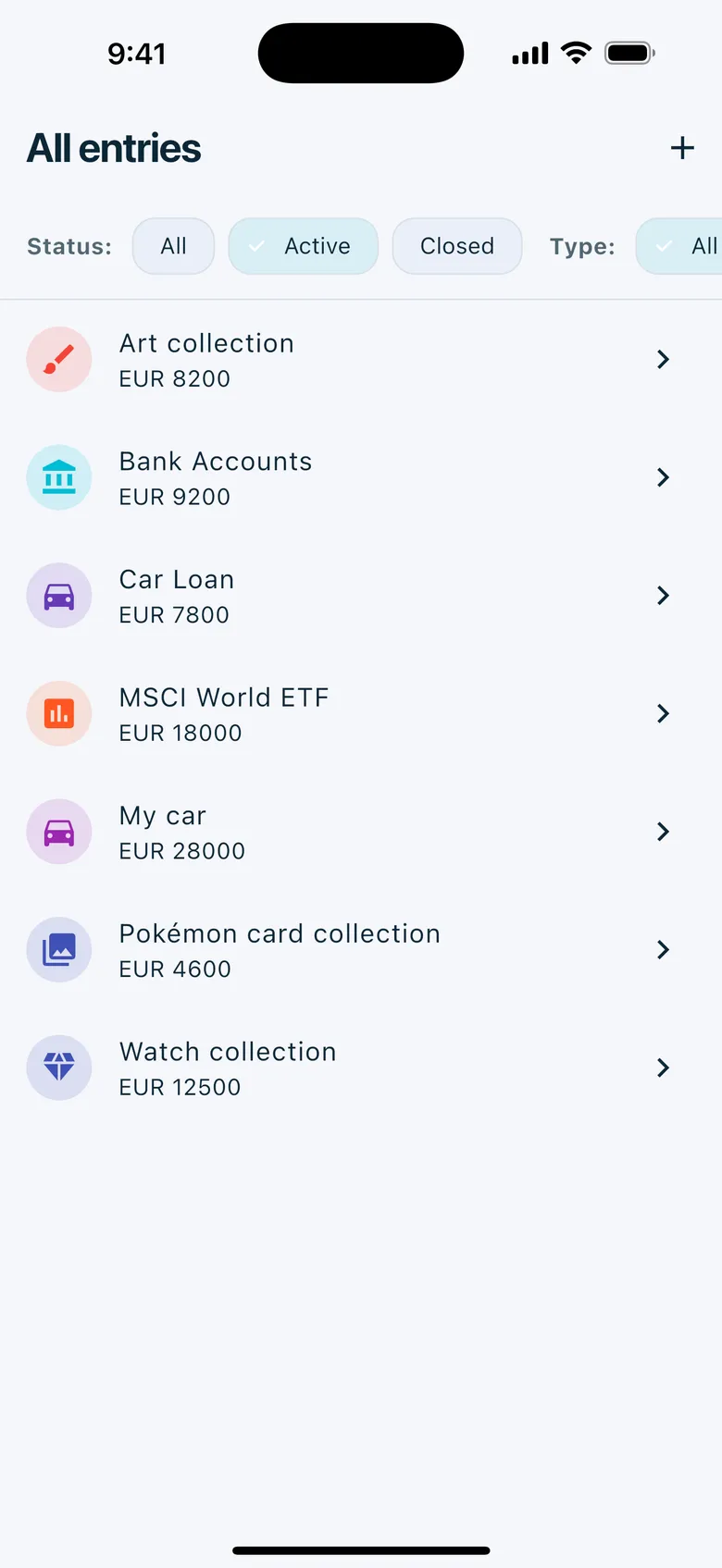
Wealth Watcher helps you keep the underlying balances and funding selection current. Revisit them when spending, contributions, access or valuation assumptions change.
Make the selection deliberate
In Wealth Watcher, keep a complete balance sheet and choose which assets fund your financial-independence goal. Excluding a collection from that goal does not remove it from net worth.
Check the funding selection when an asset becomes available, a goal changes or a new liability appears. Update dated values without treating balance changes as investment returns.
Try the website’s collection and funding example, or see how to track individual pieces inside a collection.
Before relying on a target
Does my home count?
It can count toward net worth. Counting it as retirement funding also needs a credible plan, such as selling or downsizing, with replacement housing and costs included. Living in it does not automatically create spendable cash.
Is financial independence the same as early retirement?
No. Independence describes the ability to fund your life without employment income. Someone may keep working; early retirement is one possible choice. Both require realistic costs and resources.
Is there a universally safe target?
No single multiplier settles every plan. Horizon, market uncertainty, inflation, tax, pensions and spending flexibility all matter. Revisit assumptions and get qualified advice for consequential decisions.
Educational examples, not personalised financial advice. Check assumptions, local rules and product terms before acting.